Elite Navarre (Elite Window Tinting) offers mobile window film installation throughout Navarre, FL — for cars, homes, and businesses. We reduce cabin and interior heat, block harmful UV, and help preserve fabrics and finishes. This guide explains how mobile tinting works, the benefits for automotive, residential, and commercial customers, typical pricing in the Navarre area, recommended film types, how Florida tint laws apply locally, and what to expect during an on-site install. Coastal Florida brings intense sun and UV exposure; professional window film is a practical defense, rejecting heat and blocking up to 99% of UV while keeping visibility. We break down terms like Visible Light Transmission (VLT) and the AS-1 windshield line, compare ceramic and carbon films, outline cost drivers, and map legal VLT limits so Navarre residents and rental managers can choose compliant, high-performance options. Practical examples and clear comparisons help you prioritize clarity, heat rejection, or budget while showing how a mobile installer delivers convenience and warranty-backed results.
What Are the Benefits of Mobile Window Tinting Services in Navarre FL?
Mobile window tinting brings professional installation to your location, cutting downtime and delivering immediate protection from heat and UV. Our technicians arrive with trained crews and precision cutting tools so work happens in a controlled, on-site environment — no driving vehicles to a shop or moving furniture. That means faster UV protection, fewer scheduling headaches for property managers, and less risk of fading or extra HVAC strain in Navarre's sunny climate. Mobile tinting is especially useful during peak rental seasons and for storefronts that need quick turnarounds while preserving installation quality.
How Does Mobile Tinting Provide Convenience for Navarre Customers?
Mobile tinting saves you a trip to a shop and fits around renter check-ins, business hours, or your daily schedule. Our installers come with pre-cut patterns and quality-control tools, apply film on-site, and complete inspections without asking customers to rearrange their day. This model helps property managers turn units quickly, lets vehicle owners avoid long drop-offs, and reduces logistics for larger jobs like RVs and boats. We coordinate timing so you get top-quality installation that matches local scheduling needs.
What Types of Vehicles and Properties Can Mobile Tinting Serve?
Mobile tinting covers a broad range: sedans, SUVs, light trucks, RVs, boats, single-family homes, condos, and commercial storefronts. Technicians carry films and cutting equipment suited for curved auto glass, third-row windows, and the larger panels common in homes and businesses — and marine-rated film for boat glass, which we install dockside, on the lift, or on the trailer. Most Navarre customers get a solution built around privacy, heat control, or a decorative finish, applied right where the vehicle or building already is.
How Much Does Window Tinting Cost in Navarre FL?
Tint pricing in Navarre depends on film type, window or vehicle size, glass curvature, and access or trim work. Ceramic and nano-ceramic films cost more but deliver higher heat rejection and superior clarity, while carbon-style films are a more budget-friendly choice. Residential and commercial quotes usually use square-foot or per-window pricing with labor and prep included; automotive quotes vary by vehicle class and pane count. Knowing the main cost drivers — film choice, glass complexity, and warranty — helps set realistic expectations before requesting a formal estimate.
What Are the Price Ranges for Automotive Window Tinting?
Automotive prices vary with film technology and vehicle type. Carbon-style films are an affordable entry point; ceramic and nano-ceramic options carry a premium for better performance. Carbon film starts at $149 for a full vehicle, nano ceramic at $229.99, and ceramic IR at $299.99. Larger or more complex vehicles cost more, and curved glass, third-row windows, and specialty trims add labor and material time — which is why we quote per vehicle rather than per class. Current starting prices for every film we carry are on our pricing page, and a quote is free.
How Do Residential and Commercial Tinting Costs Compare?
Residential and commercial work usually follows per-window or per-square-foot pricing. Larger commercial projects can qualify for bulk discounts and may include additional safety or permitting requirements. Residential jobs focus on clarity, UV protection, and decorative choices and are quoted per window or per room, accounting for existing treatments and access. Commercial storefronts and offices use solar-control films sized to façade areas and often include ROI considerations tied to HVAC savings. Comparing per-unit costs with expected energy and UV protection helps property owners and managers plan payback timelines and pick the right film for long-term value.
Introductory table comparing price models for non-automotive projects:
Project Type | Pricing Model | Typical Considerations |
|---|---|---|
Single-family home | Per-window or per-project | Window count, film grade, access |
Condo unit | Per-window | HOA rules, common-area access |
Commercial storefront | Per-square-foot | Façade area, structural safety film |
Use this comparison to see how quoting styles differ and which factors most affect final costs for residential versus commercial jobs.
Which Window Tint Films Are Best for Cars and Homes in Navarre FL?
Choosing the right film is about balancing heat rejection, optical clarity, UV blocking, and budget. Ceramic and nano-ceramic films offer top-tier heat rejection and minimal signal interference; carbon films are a value-focused option with good UV protection. Ceramic films use non-metallic ceramic particles to reduce infrared transmission without raising reflectivity, preserving visibility and avoiding signal disruption. Carbon films darken glass and block UV affordably but usually don't match ceramic for peak heat rejection. For beachfront homes and coastal vehicles facing strong sun, higher heat-rejection films most improve comfort and protect interiors.
What Are the Advantages of Ceramic vs. Carbon Window Tint?
Ceramic film delivers superior heat rejection and optical clarity by absorbing and dispersing infrared energy without increasing reflectivity. Carbon film offers dependable UV protection and a matte finish at a lower cost, making it a solid choice when budget matters. Ceramic films also tend to maintain in-cabin connectivity better than metalized options and generally retain optical stability longer. The right choice depends on whether your priority is maximum heat control and clarity or a more affordable, attractive finish.
Ceramic film: higher heat rejection, excellent clarity, minimal signal interference.
Carbon film: lower cost, reliable UV protection, matte aesthetic.
For Navarre's coastal sun, ceramic is often recommended when the budget allows.
These points help match film performance to local climate needs and personal priorities.
How Do LLumar and XPEL Films Differ for Navarre Customers?
LLumar and XPEL are established brands with distinct product lines: LLumar offers a wide portfolio for automotive and architectural use, while XPEL highlights nano-ceramic technology and strong heat rejection. Choice usually comes down to installer availability, product warranties, and which product line matches goals like clarity or peak heat control. Installer skill and manufacturer-backed warranty coverage are often more important than brand alone because correct application and quality control determine long-term results. Compare manufacturer specs and warranty terms to find the best match for local conditions.
Introductory table comparing LLumar and XPEL attributes for local decision-making:
Brand | Heat Rejection | UV Block | Signal Interference | Typical Cost Position |
|---|---|---|---|---|
LLumar | High (varies by line) | Up to 99% | Low | Mid-to-high |
XPEL | Very high (nano-ceramic) | Up to 99% | Minimal | High |
Carbon-style (generic) | Moderate | High | Minimal | Lower |
This comparison highlights brand-level differences that matter for Navarre's heat and UV concerns; your installer can recommend specific product lines based on on-site needs.
What Are Florida's Window Tint Laws and How Do They Affect Navarre Residents?
Florida law sets Visible Light Transmission (VLT) minimums for every window position, and requires any windshield film to sit above the AS-1 line. VLT is the percentage of visible light that passes through the glass — lower VLT means darker tint. Crucially, the legal reading is taken on film and factory glass together, not the film on its own, so a film sold as "35%" meters darker than 35% once it is installed. That is why we meter your specific glass before cutting. Installers should also confirm films meet the state's reflectivity rules and provide documentation when needed.
VLT minimums by window position under Fla. Stat. § 316.2954:
Vehicle Class / Window Position | Minimum VLT |
|---|---|
Front side windows — every vehicle | 28% |
Back side windows — passenger car | 15% |
Rear window — passenger car | 15% |
Back side and rear windows — SUV, truck, van | 6% |
Windshield | Non-reflective strip above the AS-1 line only |
These are legal minimums, not targets — going below them is a violation. Verify current statutes before installation, and note that we will not install film darker than Florida allows.
What Are the Legal Tint Percentages for Cars in Florida?
Florida requires front side windows to let at least 28% of light through on every vehicle. Behind the driver, a passenger car may go to 15% on the back side windows and rear glass, while an SUV, truck, or van may go to 6%. There is no vehicle class that gets darker front windows. The windshield may carry a non-reflective strip above the AS-1 line, and no film may impair the driver's view. Reflectivity limits prevent mirror-like finishes that could distract other drivers. Under Fla. Stat. § 316.2956, installing or selling non-compliant film is a second-degree misdemeanor — for the installer, not just a ticket for the driver — which is why we meter every vehicle and decline anything below the limit.
Research also shows window film can deliver economic and environmental benefits by lowering fuel use and emissions. By reducing cabin heat, films cut reliance on mobile air conditioning (MAC), which can reduce fuel consumption and vehicle emissions. Those energy savings translate into both environmental gains and potential fuel-cost savings.
Car Window Tinting: Fuel, Emission, and Economic Analysis
Summary: Measurements inside two common vehicles showed that closing windows and using window film significantly reduces interior UV exposure. Lower cabin temperatures reduced the need for air conditioning, which—when multiplied across vehicle fleets—can cut fuel use and emissions. The paper concludes that film application lowers peak cabin temperatures, lessens MAC energy demands, and can contribute to economic and environmental benefits when compared with implementation costs.
Are There Medical Exemptions or Special Regulations in Navarre?
Florida allows medical exemptions for some conditions that require darker tints; these exemptions need proper documentation and state filing to be valid. Medical exemptions must be certified and registered through the Florida DHSMV to avoid legal issues with non-compliant tint levels. Bring your certificate to the appointment and we will install to what it permits. Navarre residents and property owners should consult local authorities and work with professional installers to ensure compliant installations and to follow any county-specific procedures.
Why Choose Elite Window Tinting for Residential and Commercial Tinting in Navarre FL?
Elite Navarre (Elite Window Tinting) focuses on mobile service, seven-day availability, and lifetime warranty coverage on automotive tinting — practical benefits for Navarre customers who want convenient, reliable installs. Professional installation guarantees proper surface prep, precise film cutting, and compliance with VLT limits so residential and commercial projects deliver lasting energy savings and UV protection. Our mobile approach minimizes downtime for rental turnovers and business operations, helping property managers and vehicle owners keep schedules without sacrificing quality. If you want warranty-backed performance and a mobile-first workflow, Elite Navarre offers a focused set of services tailored for local needs.
How Does Elite Navarre Ensure Quality with Lifetime Warranties?
Elite Navarre includes lifetime warranty coverage on automotive tinting for material and installation defects under the terms provided at quote, giving customers long-term assurance. Our quality control pairs premium films with trained installers and post-install inspections to verify clarity and adhesion. Warranties are activated after the final inspection and documentation; we keep records to support future service calls. Ask for warranty details in your itemized quote so you clearly understand coverage and any exclusions.
What Energy Savings and UV Protection Benefits Do Customers Experience?
High-performance solar-control films lower interior temperatures, reduce HVAC load, and block up to 99% of ultraviolet radiation — protecting furnishings and occupants while improving comfort in Navarre's warm coastal climate. Energy savings depend on film performance, window orientation, and the building envelope, but many projects see measurable reductions in HVAC runtime and slower interior fading. For vacation rental managers, lower cooling demand improves guest comfort and reduces operating costs over time, helping justify higher-performance films. Choosing films with strong heat rejection and UV block maximizes occupant comfort and preserves interiors.
How Is the Elite Navarre Mobile Window Tinting Installation Process Conducted?
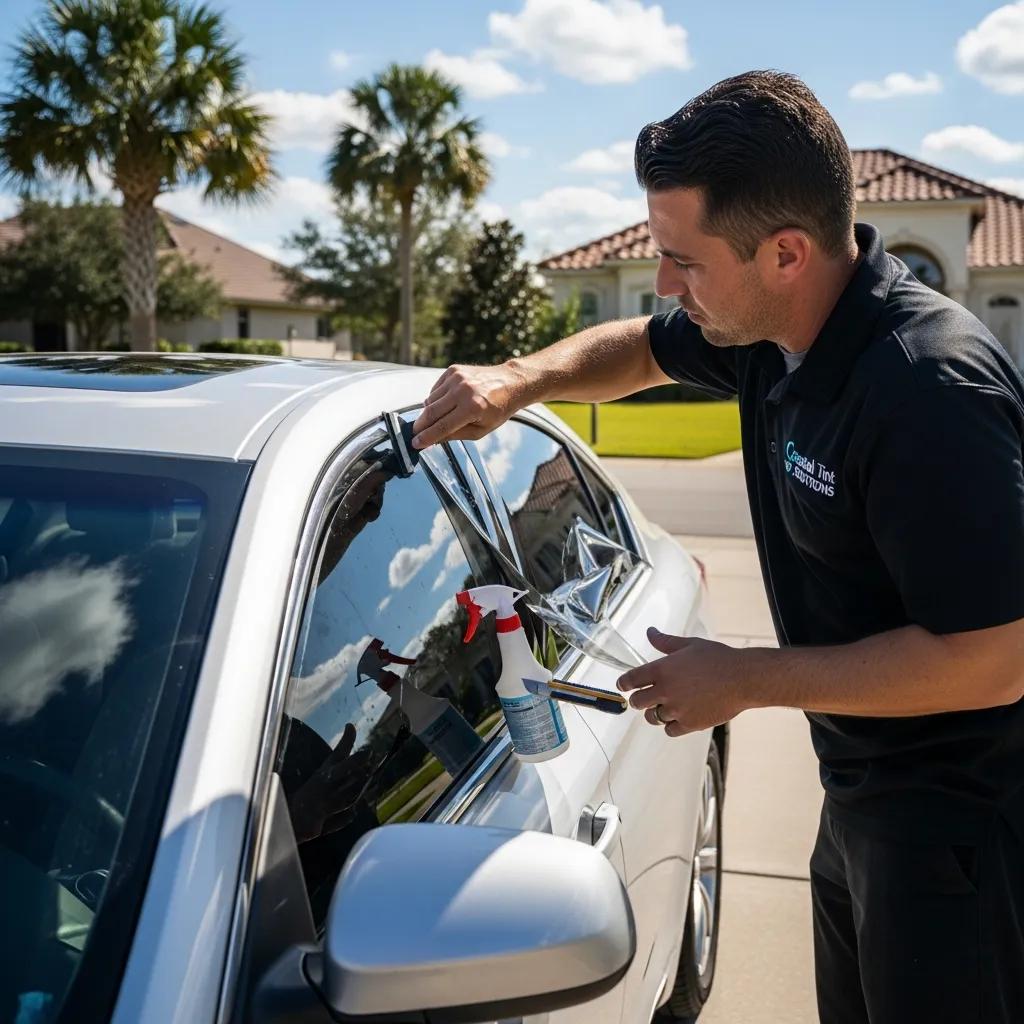
Our mobile installations follow a clear workflow: pre-site assessment and quote, on-site preparation and cleaning, precision measurement and cutting, careful application and squeegeeing, curing and inspection, and a final customer walkthrough. This process ensures proper adhesion, alignment with AS-1 windshield rules, and cosmetic finishes that meet manufacturer standards. Mobile teams bring the right tools and controlled practices to reduce contamination during application. Clear communication about access, expected duration, and aftercare helps ensure a smooth installation for vehicle owners and property managers.
What Steps Are Involved in Mobile Tint Installation?
Typical mobile installation steps include scheduling and pre-site assessment, protective setup and glass cleaning, precision measurement and film preparation, careful application with squeegee work to remove moisture and bubbles, curing time for the adhesive, and a final inspection with the customer. Each step focuses on contamination control, exact edge alignment to trims and seals, and following recommended curing times for long-term adhesion. Installers provide documentation and care instructions to help maintain film quality and warranty coverage. Knowing these steps helps you plan site access and expected downtime.
Scheduling and Assessment: Confirm site access and measure windows for accurate quoting.
Preparation and Cleaning: Remove dirt and residue that can affect adhesion.
Film Application and Curing: Apply film carefully, squeegee moisture, and allow adhesive to set.
These steps summarize the workflow and set expectations for timing and customer cooperation during mobile installs.
How Does Elite Navarre Maintain High Customer Satisfaction?
We keep customers satisfied through responsive scheduling — including seven-day availability — clear warranty terms on automotive work, and post-install support for any adjustments. Follow-up inspections and detailed installation records help resolve issues quickly and preserve long-term performance. By combining premium film options, mobile convenience, and transparent quoting, Elite Navarre delivers a single-source experience focused on compliance, performance, and ongoing support for installed films.